
Designing a scalable prerequisite system for training compliance

Overview
The LMS is used by airlines and training organizations to manage required training for crew and staff.
Each training program includes rules that define what a user must complete before progressing. These rules are critical because they ensure that training follows the correct sequence and meets regulatory requirements.
Prerequisites are therefore not optional logic. They directly control whether a user is compliant or not.
Lead Product Designer
Led the redesign of prerequisite logic within the LMS, working with Product and Engineering to make training requirements easier to define, understand, and maintain at scale.
Collaborators
Product, Business, Engineering
The Challenge
The workflow gave users access to data, but it did not guide them through evaluating it.
Users often had to move across multiple views to understand one location. They would start with a dashboard, open a location, review detailed reports, compare historical updates, and interpret category results on their own. The system showed the pieces, but did not help users understand how those pieces connected.
This created two problems. First, the workflow was repetitive because users had to follow the same manual path for each location. Second, the workflow relied too much on the user to decide what mattered.
The result was slower review, higher cognitive effort, and inconsistent interpretation between users.
Approach
The redesign focused on turning prerequisites from a manual setup task into a structured system.
The goal was to make training logic:
-
easier to define
-
easier to understand
-
easier to maintain as programs grow
This required shifting from isolated course-level configuration to a more structured and consistent way of defining relationships between courses.
The key decision was to treat prerequisites as part of the training system itself, not as individual settings attached to each course.

Key Solutions
Structuring prerequisite logic instead of repeating it
Prerequisites were previously defined individually for each course, which led to repetition and inconsistency.
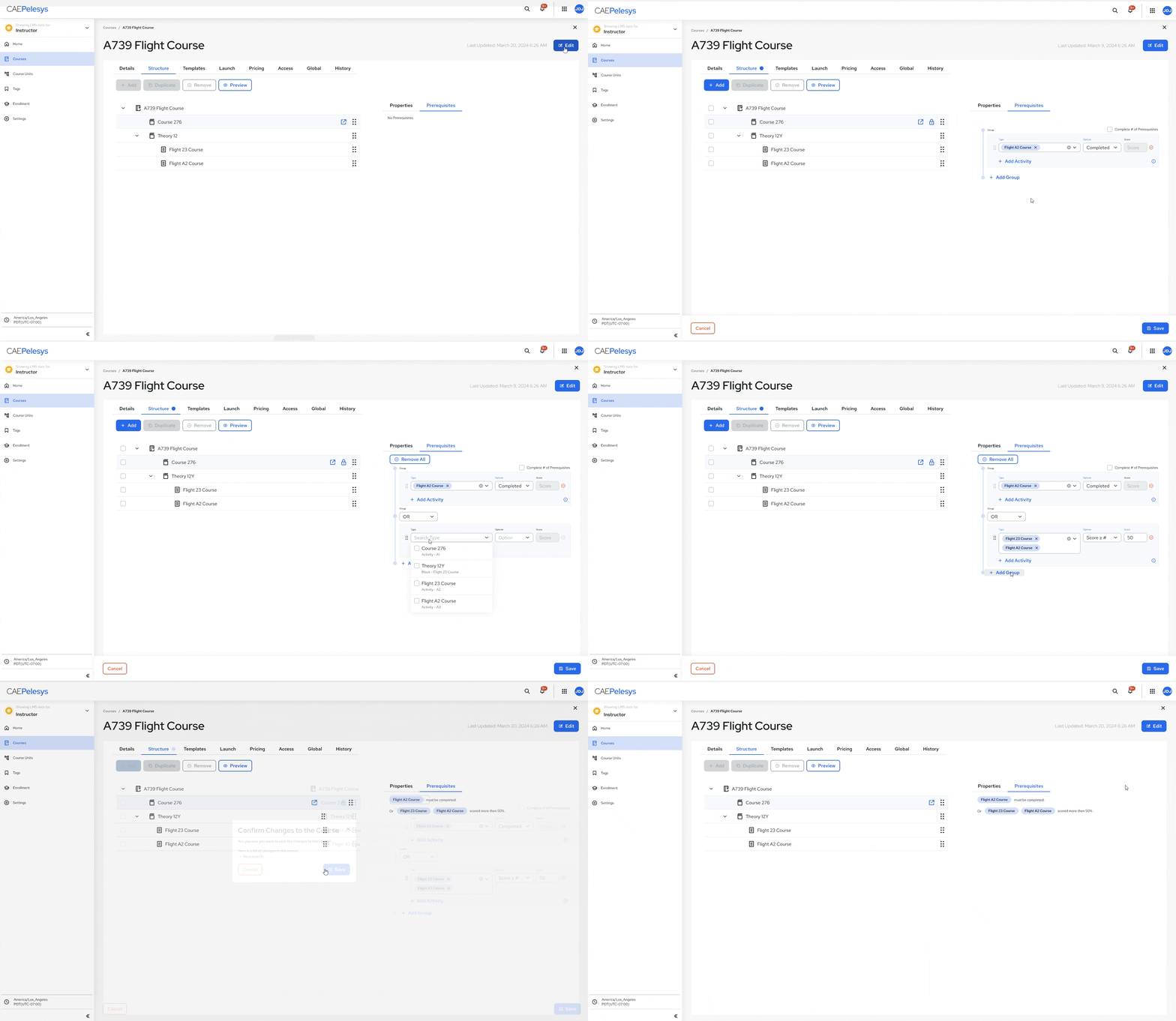
The system was redesigned to support a more structured approach, where relationships between courses could be defined in a consistent way. This reduced duplication and made the logic easier to manage across multiple training programs.
Reducing the risk of configuration errors
Because prerequisites control training eligibility, errors have direct consequences.
The new structure reduced the number of manual steps required and made relationships more explicit, lowering the likelihood of incorrect setup. Users could define requirements with more confidence because the system supported validation through clarity.
Making training dependencies visible and understandable
Users needed to understand how courses were connected in order to configure them correctly.
The redesigned system made prerequisite relationships clearer, allowing administrators to see how one course depends on another. This reduced reliance on memory and made it easier to validate configurations before applying them.
Designing for scale across growing training programs
Training programs can expand significantly over time.
The redesigned approach allows prerequisite logic to scale with the system, without requiring administrators to rebuild or duplicate configurations. This made it possible to manage larger and more complex training structures without increasing effort.
Outcome
The redesigned prerequisite system made training logic easier to manage and more reliable.
Administrators can now define training requirements with fewer steps, understand how courses are connected, and reduce the risk of errors that could affect compliance.
The value of this work was not in adding new functionality.
It was in restructuring how prerequisite logic is defined so that complex training requirements can be managed clearly, consistently, and at scale.